From
Aurel
freelance
career
Freelance Is the New Default: Why Game Studios Are Betting on Flexible Talent
I've been talking to a lot of studios lately. Art directors, outsourcing leads, production managers. And there's a pattern that keeps coming up in every conversation.
They all want more freelancers. Not fewer. More.
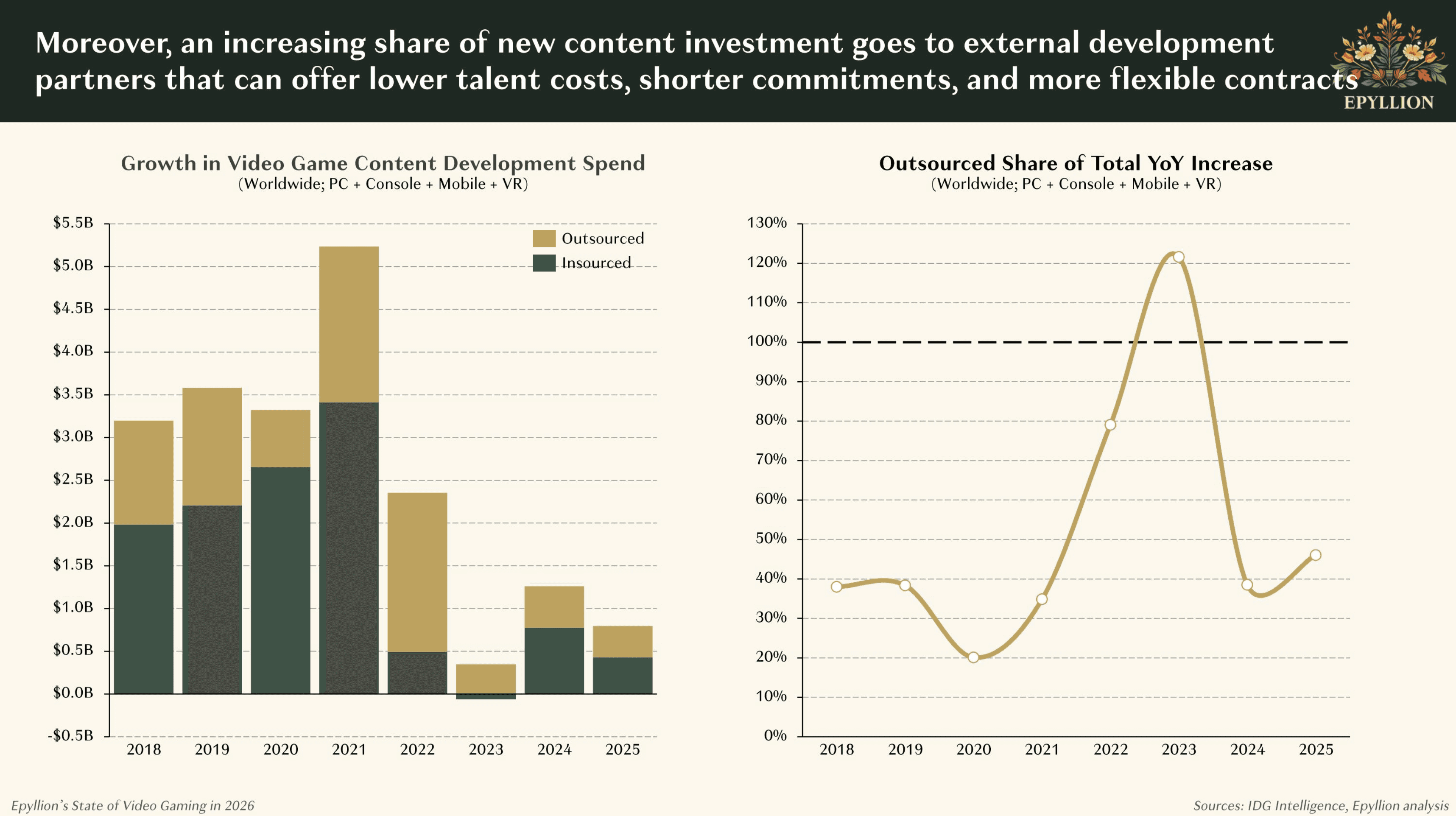
Which is strange, because the game industry just went through the worst layoff cycle in its history. Over 45,000 jobs gone since 2022. Microsoft alone cut 1,900 people across Xbox and Activision Blizzard in a single announcement. Sony let go of 900, including people at Insomniac. Embracer Group basically cut their workforce in half, shutting down 44 studios.
And these aren't small companies running out of money. The industry made close to $200 billion last year. EA laid off the Battlefield team right after the franchise posted its highest sales ever. Revenue is up. Headcount is down.
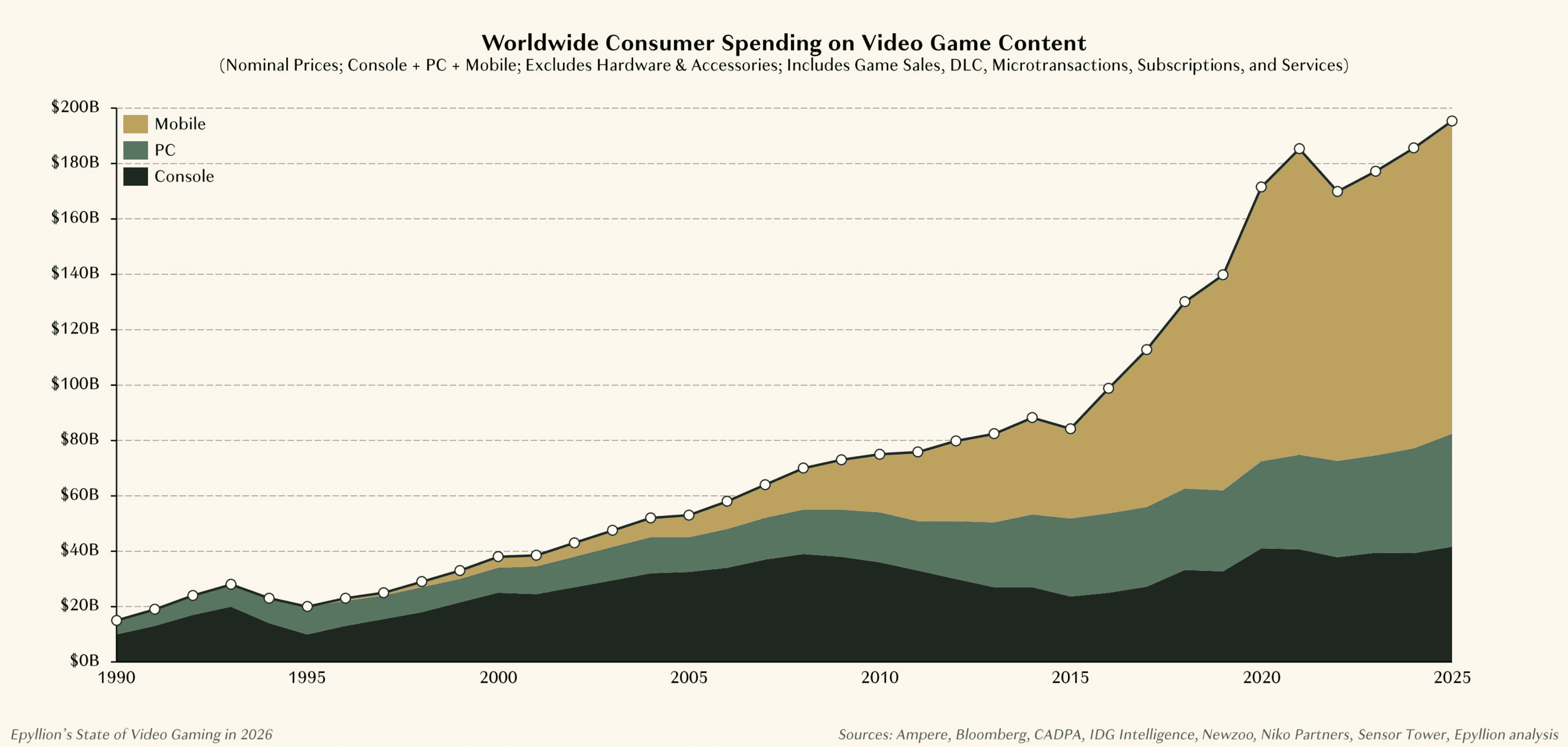
Source: The State of Video Gaming in 2026, Matthew Ball / Epyllion
If you're a concept artist trying to make sense of this, here's what's actually happening.
The work didn't disappear. The hiring model changed.
Studios aren't cutting art teams because there's less work. They're cutting them because they've realized they don't need permanent teams for work that comes in waves.
Think about how a game gets made. Pre-production needs a ton of concept art. You might have five environment artists, three character designers, a vehicle specialist. Then production starts, and suddenly the concept team shrinks to one or two people doing revisions while the 3D team takes over. Then the project gets delayed, or the direction changes, or the whole thing gets cancelled. Embracer killed 80 active projects during their restructuring. Microsoft cancelled Everwild after ten years.
Keeping large permanent art teams through these cycles is expensive. So studios are doing something different: they're hiring freelancers for the specific phase they need, then releasing them when the phase ends.
The numbers back this up. About 60% of game studios now outsource art tasks. The game art outsourcing market is growing at roughly 10% per year. Studios report saving 40-60% compared to full-time hires for specialized, short-term work.
This isn't a blip. It's the new structure of the industry.
Source: The State of Video Gaming in 2026, Matthew Ball / Epyllion
The freelance chain is longer than you think
Here's something a lot of artists don't realize about how their work actually gets to them.
The biggest concept art outsourcing studios in the world, places like Karakter in Berlin, or SIXMOREVODKA, or One Pixel Brush, they don't just have big internal teams. They operate with a core staff plus an extended network of freelance artists who get brought in per project.
So the chain looks like this: a AAA game studio like Sony or Riot outsources to an art studio like Karakter, and Karakter brings in freelancers to execute the work. An artist might be painting God of War environments through Karakter without ever talking to anyone at Sony directly.
This layered model creates real opportunity. In a single year, one freelancer can contribute to three or four major titles across different outsourcing studios. You're not stuck on one project for two years hoping it ships. But the flip side is obvious: no single gig is guaranteed to last, and you need to keep the pipeline full.
What the GDC survey actually tells us
The GDC 2026 State of the Industry report surveyed over 2,300 developers. Some of the numbers are rough.
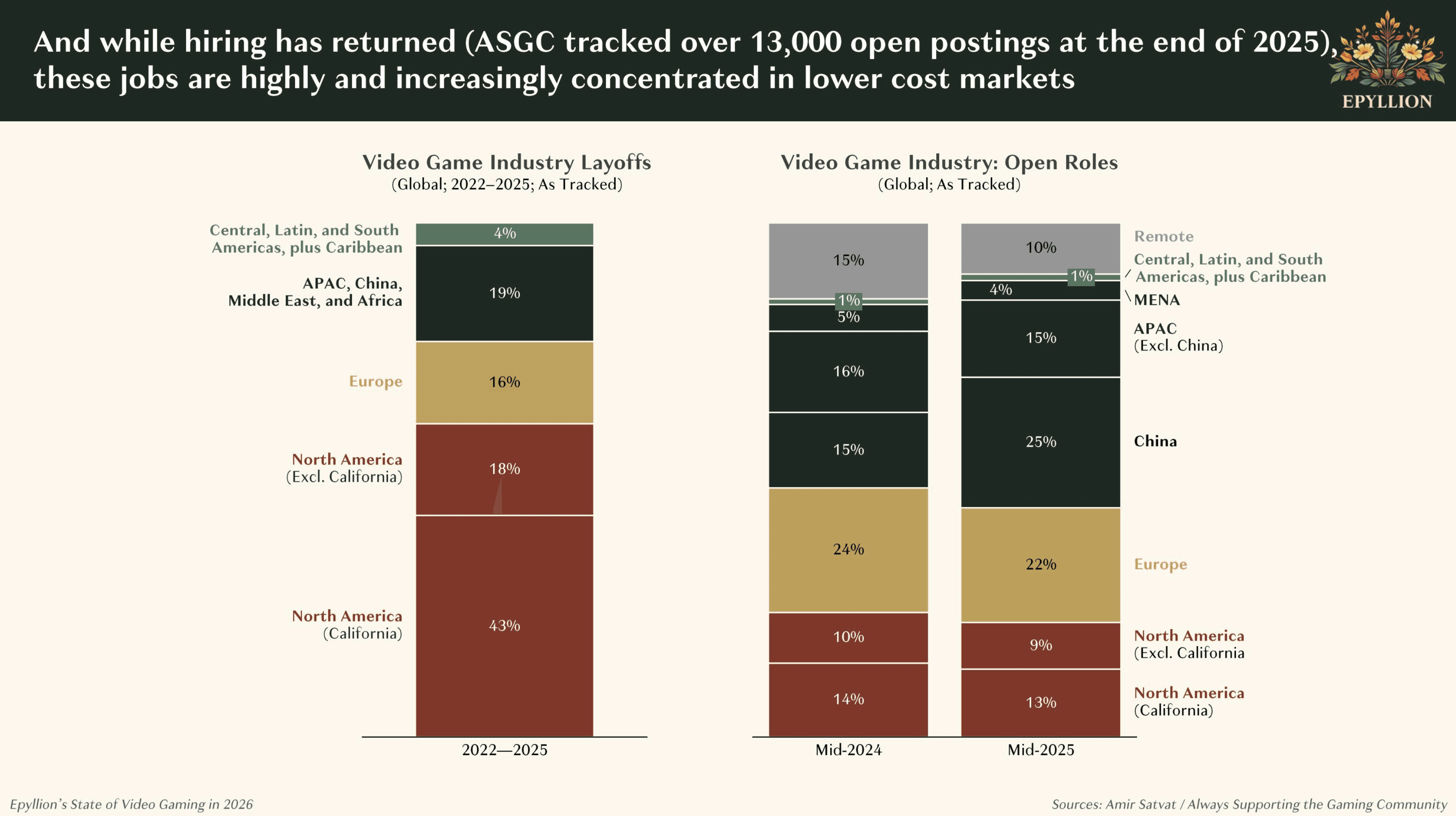
One in three US game developers got laid off in the past two years. Of those, nearly half still haven't found a new job. Two-thirds of people at AAA studios said their company had layoffs. And 74% of students said they're worried about finding work, because they're now competing with experienced artists who just got cut.
Source: The State of Video Gaming in 2026, Matthew Ball / Epyllion
But here's the part that doesn't get enough attention: 35% of respondents are now self-funding their own projects. Only 20% rely on publishing deals. People are building their own things, going independent, freelancing by necessity and sometimes by choice.
The old path of graduate, get hired at a studio, climb the ladder for 15 years is still possible. But it's no longer the default. For a growing number of concept artists, freelancing isn't Plan B. It's the main path.
So what do you actually do about it?
If you're building a career in concept art right now, the playbook is different from what it was five years ago. Here's what we're seeing work.
Specialize. Studios hire freelancers who are great at one thing, not decent at everything. Whether it's environments, characters, hard surface, or creatures, pick a discipline and go deep. The outsourcing studios that feed you AAA work want specialists they can rely on for a specific type of delivery.
Let your portfolio do the talking. The industry is moving toward portfolio-first hiring. Process breakdowns, shipped work, and clear specialization beat a resume with a famous studio name but no visible output. Show what you can do, not where you've been.
Learn the business side. If freelancing is the default, then you're running a small business whether you like it or not. Pricing, contracts, client communication, invoicing, taxes. These aren't distractions from the art. They're part of the job now.
Build relationships with outsourcing studios. Karakter, SIXMOREVODKA, One Pixel Brush, Kevuru, RocketBrush. These companies have direct pipelines to AAA clients. Getting into their network can provide steadier work than cold-pitching studios yourself.
Don't rely on one industry. Film, advertising, TV, tabletop, VR. They all need concept art. The artists who handle volatility best are the ones with multiple revenue streams. When game budgets get cut, advertising budgets might be going up. Spread the risk.
Network like it matters, because it does. Most freelance gigs come through referrals, not job boards. Show up at events, engage on ArtStation and LinkedIn, be active in Discord communities. The best opportunities are rarely posted publicly.
The honest version
The game industry isn't dying. It's making more money than it ever has. But the way it employs people is changing fast, and that change disproportionately affects artists.
If you're a concept artist in 2026, you're probably going to freelance for at least part of your career. Maybe most of it. That's not a failure. It's just the shape of the industry now.
The artists who do well in this environment are the ones who treat their craft like a business, specialize hard, keep their portfolio sharp, and never stop building relationships.
That's what we're trying to build at ConceptCore. Not just teaching people to draw better, but preparing them for the industry as it actually works today.
Sources
Matthew Ball / Epyllion, The State of Video Gaming in 2026 (167-slide presentation, April 2026)
GDC 2026 State of the Game Industry Report (2,300+ respondents)
Learn what studios actually look for
Each Conceptcore course includes real production-style briefs and assignments that reflect what studios want to see.
You won’t just finish with a "cool-looking" piece. You’ll finish with a portfolio-ready image that fits the logic of production: storytelling, design language, asset reusability, and more.
We even partner with studios to sponsor real briefs and scout graduates.
Previous article
Next article
From
Aurel
Conceptcore Founder, Art Director
Ricardo Padierne
SIXMOREVODKA, NETEASE
16 hours, 32 minutes
Course Duration
The Full Process of Character Design
Experience a new standard of video-on-demand learning. We select top artists and completely retro-engineer their art to reveal exactly how they work. Born from months of dedicated preparation and filmed in our Parisian studios, every Masterclass is crafted to be the most entertaining and practical resource for your artistic growth.
REALISTIC
text
CHARACTER
text
text
FANTASY
text
text
$269.00
Ulysse Verhasselt
Riot, WestStudio, Amazon
10 hours, 41 minutes
Course Duration
Stylized Architecture
Good architecture isn't just about cool shapes, it's about understanding how a building actually functions. We'll show you how to take a rough idea, block it out in 3D, and paint over it to make it look hand-crafted and authentic.
STYLIZED
text
ENVIRONMENT
text
text
FANTASY
text
text
$269.00