Good afternoon,
CHAPTER 0: Artist Introduction
CHAPTER 1: Course Introduction
CHAPTER 2: Design Intent
CHAPTER 3: Briefs and Refs
CHAPTER 4: Building The Blueprint
CHAPTER 5: 3D Bockout
CHAPTER 6: Refined 3D
CHAPTER 7: Back to 2D

Degenesis, Titankill, Falcon
Explore second assignment by ricardo padierne in this Character Design lesson with Ricardo Padierne. Build your character art skills at ConceptCore.
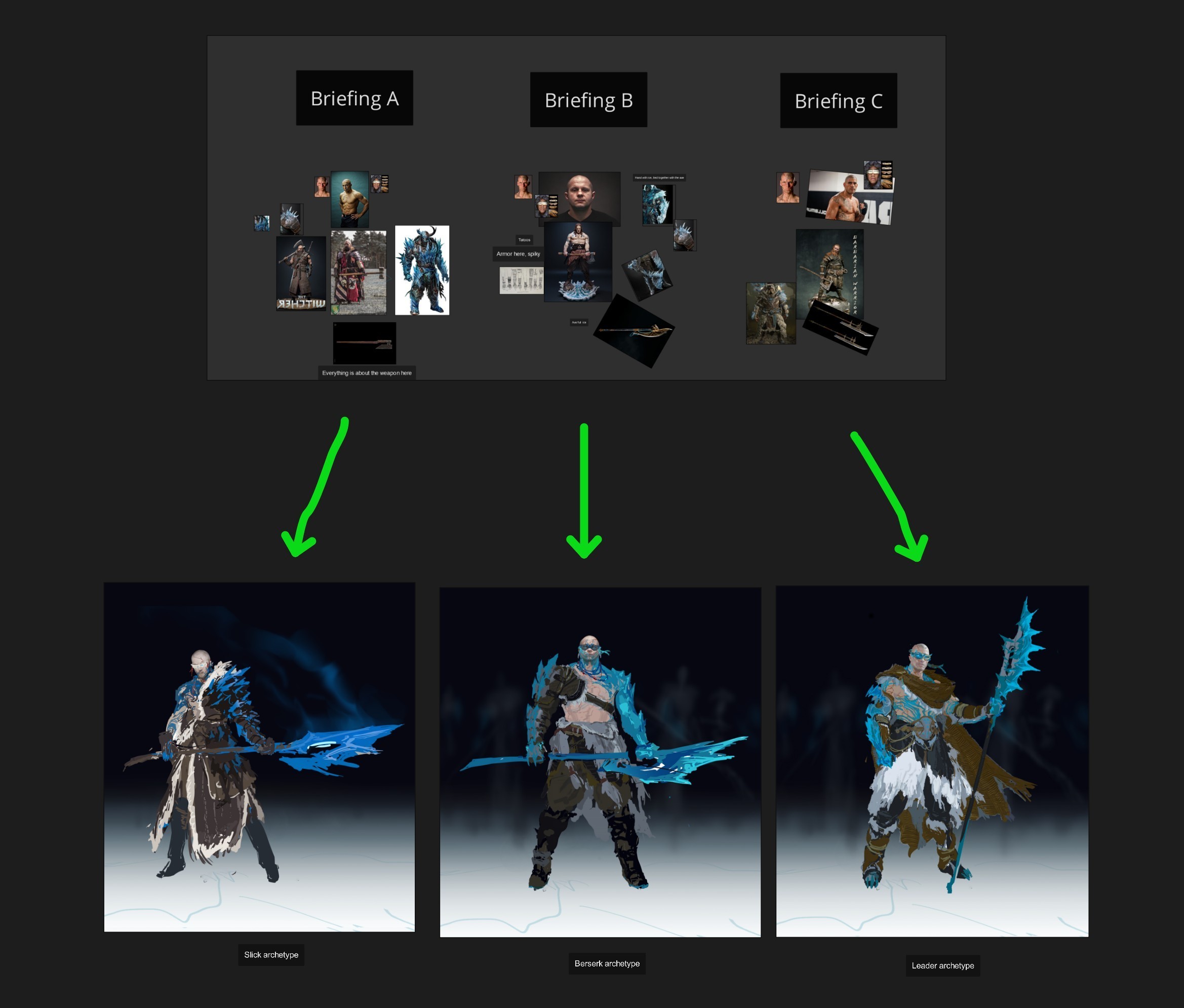
You will create three distinct design explorations based on the separate reference boards you prepared in the previous step. In my demo, I have taken the same base character concept and defined them with attached subroles—showing a 'Slick/Agile' version, a standard 'Berserk' version, and a 'Leader' archetype—but feel free to delimit your own subdefinitions to fit your goals. The most important aspect is that while it remains the same character, these three sketches must feel distinct from one another, heavily influenced by their specific briefing board. Take time with each sketch to ensure the specific subrole is clearly communicated through their pose, silhouette, and equipment. There is no rush. This step is meant to challenge the flexibility of your core concept. Try to push the unique identity of each variation to bring the most out of your design!
Degenesis, Titankill, Falcon
Explore second assignment by ricardo padierne in this Character Design lesson with Ricardo Padierne. Build your character art skills at ConceptCore.
You will create three distinct design explorations based on the separate reference boards you prepared in the previous step. In my demo, I have taken the same base character concept and defined them with attached subroles—showing a 'Slick/Agile' version, a standard 'Berserk' version, and a 'Leader' archetype—but feel free to delimit your own subdefinitions to fit your goals. The most important aspect is that while it remains the same character, these three sketches must feel distinct from one another, heavily influenced by their specific briefing board. Take time with each sketch to ensure the specific subrole is clearly communicated through their pose, silhouette, and equipment. There is no rush. This step is meant to challenge the flexibility of your core concept. Try to push the unique identity of each variation to bring the most out of your design!
15 chapters
15 chapters
9 chapters